The Business is Yours. The Payment Infrastructure is Ours.
Four intelligent systems run underneath every transaction your business processes. Each one handles a different part of the revenue cycle. All of them run automatically from day one.
01 — SETUP
You're not setting up a payment page. You're building how your business gets paid.
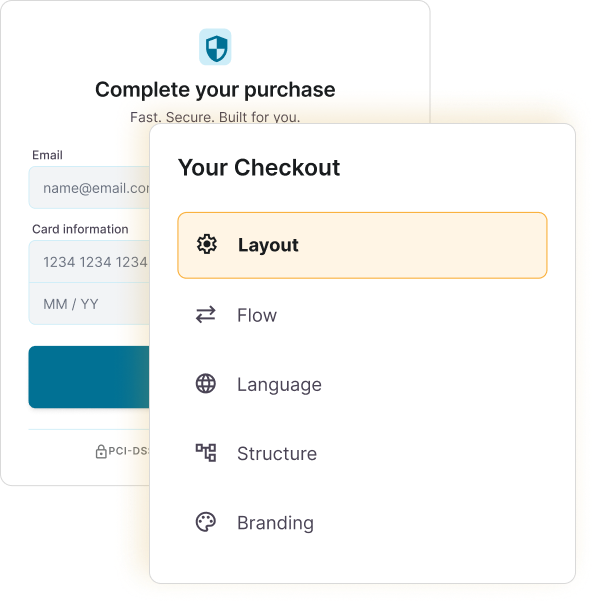
It's already your business when you open it.
Your branding, your details, your context — all pulled in before you've touched a thing. You're not starting from scratch.
You decide what your customer sees.
The layout, the flow, the language, the structure — every part of the checkout experience is yours to shape. If it doesn't feel right, you change it.
You see it the way your customer will.
Every adjustment you make shows up in real time. What you're building is already behaving the way it will for a real customer — while you're still working on it.
No guessing, no surprises.
There's no preview mode to reconcile with. No "let me see how that actually looks when it's live." What you see is what they get.
When it feels right, you hit publish.
That's it. It goes live immediately — everywhere. One build. Every surface. Your website, a payment link, an SMS, an email, a QR code, an API call. Nothing is set up twice. Nothing managed separately.
02 — ACCEPTANCE
Every customer you talk to should be a customer you close.

Most payment systems are built to filter people out.
They run a check, decide who qualifies, and quietly turn the rest away. That lost percentage gets written off as normal. It isn't.

Every customer who shows up has already decided they want what you offer.
They chose you. Credee doesn't second-guess that. The acceptance system is built from the start to find a way to say yes — not to look for reasons to say no.

Nobody gets turned away at the door.
Not because the system is ignoring risk. Because it was built differently. Every customer who engages with your business gets a path to complete the transaction.

Every customer who comes through makes the system smarter.
It learns your vertical, your customers, and the patterns that lead to completed transactions. The more it sees, the sharper it gets.
03 — PROTECTION
The system isn't waiting for something to go wrong. It's already on it.
Every checkout is being watched from the moment it's done.
Not at the end of the month. Not after something misses. Constantly. From the moment the checkout is completed.
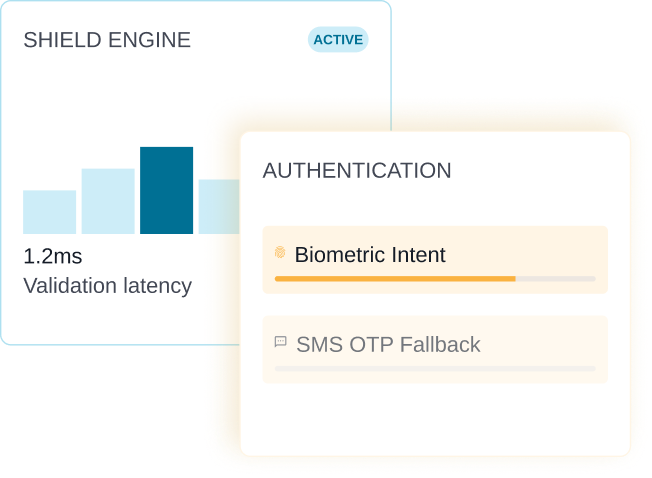
When Checkout Shield picks up a signal, it moves before you do.
A pattern, an anomaly, anything that looks like it's heading toward a missed payment — it adjusts automatically. Your customer doesn't notice. The revenue doesn't move.
If a payment does drop, Checkout Recovery is already running.
It kicks in immediately. Runs a recovery sequence built from what's actually worked for businesses like yours. Follows up at the right moments. Recaptures quietly. No calls from your staff. No chasing.
The risk is ours, not yours.
That's not a footnote. It's the whole point. Universal acceptance only works if the downside sits with us, not with you.
04 — INTELLIGENCE
The less you have to think about getting paid, the more you can think about everything else.
Following up. Checking what's working. Adjusting what isn't. Making calls that feel like guesswork. Credee is built to take all of that off your plate.
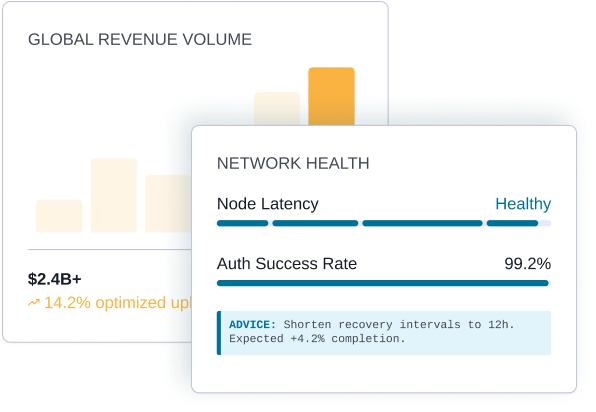
Every checkout, every completion, every drop, every recovery — across your business and every comparable business on the platform. It knows what's working right now, in your vertical, at your transaction size.
Not "consider adjusting your checkout." More like — shortening initial payment intervals increased checkout completion by 23% across 412 comparable businesses in your category over the last 90 days.
Within whatever boundaries you set, it applies the optimizations automatically. checkout structure, recovery sequencing, payment timing — continuously refined against live data. No manual input.
Review requests go out when satisfaction is actually at its peak. Reminders land when they're most likely to work. Recovery starts the moment a payment drops — not when someone notices it did.
Two years from now, the businesses that are winning aren't going to be the ones who got better at managing payments. They're going to be the ones who trust smart decisions to optimize the checkout flow.
The businesses that will own the next ten years aren't waiting for the infrastructure to catch up to them.